IB Curriculum
American University Research Academy became an IB Candidate School in the Fall of 2022 for both the Middle Years Program (MYP) and the Diploma Program (DP). The IB program embraces a holistic view of education that goes beyond academic rigor. By embracing an international mindset and engaging in service and meaningful experiences, students develop character and skills necessary to thrive in the 21st century.
After a comprehensive authorization process, the International Baccalaureate Organization officially authorized AURA to offer the Diploma Program on June 25, 2024, and the Middle Years Program on July 22, 2025. AURA is now officially recognized as an IB World School authorized to deliver both programs.
The IB program at AURA provides a rigorous education for students in grades 9 through 12. Students in grades 9-10 complete the Middle Years Program and students in grades 11-12 complete the Diploma Program. The IB program is unique in that it provides a cohesive, interdisciplinary education leading to a diploma recognized by universities worldwide.
Middle Years Program
The MYP curriculum consists of eight subject groups and two elements: service action and community/personal project. Student achievement in the MYP is assessed against the IB prescribed subject-specific criteria.
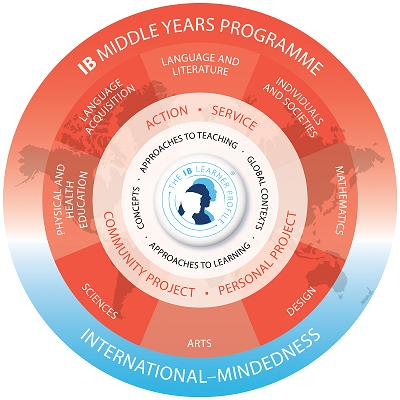
At AURA, students study the following IB MYP courses in grades 9-10
- English language and literature
- Language acquisition
- individuals and societies
(History and Political Sciences) - Sciences (Biology, Chemistry and Physical Sciences)
- mathematics
- Visual Arts and Music
- Design
Diploma Program
An IB diploma candidate pursues studies across multiple subject areas:
- Studies in Language & Literature: English (with Spanish for fluent speakers as an additional option)
- Language acquisition
- Individuals & Societies (similar to social studies)
- Experimental Sciences
- Mathematics
- The Arts or a sixth subject elective.
In addition to the coursework and assessments in these six subjects, diploma students must complete a Creativity, Activity, Service (CAS) component (requiring an equitable balance of participation in creativity, activity and service experiences for 18 months), an extended essay (EE) of 4,000 words, and the Theory of Knowledge course (TOK).
Teachers provide interdisciplinary instruction in which students study common processes, themes, and materials within and across subject areas. Evidence of learning in the six subject area courses plus TOK includes a combination of internal and external assessments. The IB designs internal assessments, but the classroom teacher administers and scores them using IB scoring rubrics. IB examiners score external assessments, including the May examinations and additional assessments for courses in groups 1 & 6. The extended essay is graded externally by IB examiners. Students who participate in the full diploma program will fulfill the State of California graduation requirements and IB diploma requirements.
The Curriculum
The focus of the curriculum will be the courses prescribed by the framework pictured below:
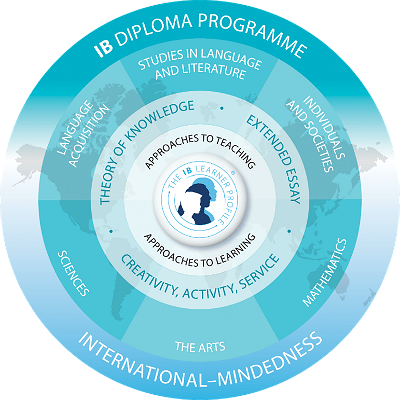
The curriculum includes six subject groups and a compulsory core made up of three parts central to the philosophy of the diploma program. Full diploma candidates must take three courses at the Higher Level (HL, two-year courses representing 240 teaching hours) and three courses at the Standard Level (SL, one- or two-year courses representing 150 teaching hours). Students can thus explore some subjects in depth and others more broadly. Science-oriented students are challenged to learn a foreign language, and natural linguists become familiar with laboratory procedures. Active citizenship and global perspectives are encouraged in each area of the curriculum.
Students who do not wish to fulfill all the requirements of the IB Diploma are strongly encouraged to take individual courses in the IB curriculum to help them prepare for future education. These subjects are referred to as Diploma Program (DP) courses, and the students who study them are referred to as Diploma Program (DP) course students.
At American University Research Academy, we offer the following courses in the six curricular IB groups in the DP program:
- English Language and Literature HL
- Arabic Language ab initio SL
- Economics HL
- Mathematics Applications & Interpretations SL
- Biology HL and Chemistry HL
- Visual Arts SL
HL – Higher Level
SL – Standard Level
Approaches to Teaching
Teaching in the IB program is:
- Based on inquiry
- Focused on conceptual understanding
- Developed in local and global contexts
- Focused on effective teamwork and collaboration
- Designed to remove barriers to learning
- Informed by assessment
Approaches to Learning
Students “learn how to learn” by developing Approaches to Learning skills, which apply across the curriculum and support the IB learner profile attributes. ATL skills include thinking, communication, research, self-management, and social skills. Learners can learn and be taught them, improve them with practice, and develop them incrementally. They provide a foundation for learning independently and with others.